Guide to the Quantum Future: How We Got to Now


Quantum computing, if one takes well-eyeballed headlines on the topic seriously, is by 2026 well on its way to being the computer of the future.[1] The new computing substrate, often discussed in acclamatory and almost mystical tones by tech luminaries, promises to revolutionize, if not the entire field of computer science, many highly influential areas that once seemed like permanent stumbling blocks to earlier progress. Previously intractable problems across domains such as physical simulation, cryptanalysis, and machine learning, having long served as unavoidable bottlenecks, will suddenly be tractable.
Historically, advancements in computing were driven by demand for cryptographic technology and that is no different with quantum computing. This article will be the first in a series of 3 diving into quantum computing and its effects on the field of cryptography. To understand the future, we will first go into the past and outline where we were, where we are, and finally where we are going.
1980-1999: Foundations and Fears (in Theory)
The ultimate origins of quantum computing, like most technologies, lie far in the past, in the "quantum revolution" (or, increasingly, the "'first' quantum revolution") of the early 20th century, with important developments in physics such as Max Planck's quantum hypothesis and Niels Bohr's atomic models dramatically rewriting humanity's collective understanding of the physical world. But it was seven and a half decades later that two American physicists, Paul Benioff at Argonne National Laboratory and Richard Feynman at Caltech, in 1980 and 1982 respectively, proposed that quantum mechanical principles themselves could be used to constitute a new and advanced computing substrate. Both researchers proposed that if a computer could be practically built that took advantage of the quantum nature of the universe, it would be far more efficient and adept at quickly solving certain categories of problems that are difficult or impossible for classical computers, which excel at certain tasks but, like most computing substrates, have severe limits elsewhere. These developments, while intellectually interesting to some, did not spread widely outside of specialized corners of academia until a flurry of dramatic developments in the middle of the next decade.
In 1994, mathematician Peter Shor would publish a theoretical quantum algorithm, eventually known as Shor's algorithm, that sketched out in detail a method for efficiently solving the problem of prime factorization. Although quantum computers were demonstrably far away from practical reality, this was a bombshell result for two significant reasons. Firstly, this was the first time that a quantum algorithm had been devised that could have significant consequences, with prime factorization being the foundation of modern public-key cryptosystems that made the internet possible. Secondly, and even more significantly, prime factorization was the only known workable method of powering public-key cryptography at the time. Theoretical proposals for other methods such as elliptic-curve cryptography did exist, but were yet to be operationalized and implemented (between 1999 and 2005)[2], and as discrete log systems, they were also vulnerable to Shor’s algorithm. As a result, the world woke up one day to learn that their only known way of securely transmitting data over a network would be trivially breakable, as soon as a machine could be built to run the algorithm.
While this alone would likely have led to an explosion of interest, the next two years contained numerous important advances that contributed to quantum computing emerging as a widely known theoretical technology, as seen in the graph below.
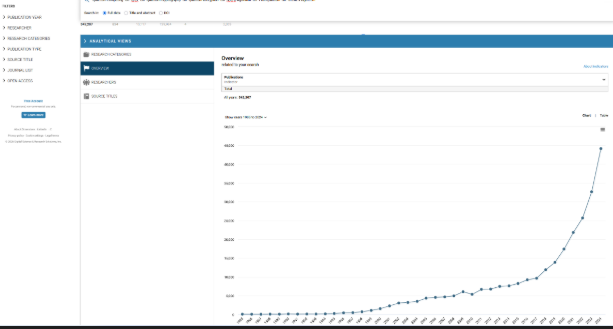
In 1995, Peter Shor also published the first quantum error-correcting code. This brought the practical construction of a quantum computer significantly closer, as error correction remains a difficult problem even today for quantum computers. The following year, two Israeli computer scientists, Dorit Aharonov and Michael Ben-Or, demonstrated a method for performing fault-tolerant quantum computation, again bringing the likely possibility of eventually constructing a quantum computer closer.
Finally, in 1996, Lov Grover published Grover's algorithm. Grover's algorithm promised significant computational advantages to a quantum computer searching a database or keyspace, essentially doing to symmetric-key cryptography what Shor's algorithm had done to public-key cryptosystems (although the increase in speed was quadratic vs. exponential). The stage was set for the panic that was to ensue, as government, business and technology leaders scrambled to understand the implications for the future of data security and the internet.
2000-2020: Baby Steps Towards Application
The first decade of the new millennium, quantum-wise, was characterized by a "quantum winter", with pervasive anxieties about the perils of the new cryptanalytic machines widespread in the technical and popular press,[3] and small steps being made on various fronts towards progress. In 2000, MIT researcher Edward Farhi invented a promising new hardware alternative known as adiabatic quantum computing, leaving would-be manufacturers of quantum computers with several options.[4] Shortly thereafter, researchers at IBM created a "toy" quantum computer in 2001, which performed Shor's algorithm on the number 15, successfully decomposing it into 3 and 5 with 7 qubits. It would remain the most impressive real-world use of quantum computing for some time. The turn of the millennium saw the founding of D-Wave, the first commercial enterprise dedicated to attempting to create physical quantum computers. D-Wave debuted the first quantum hardware in 2007, using a technology known as quantum annealing.
After the relative lack of investment or interest in quantum computing aside from periodic scaremongering in technology media, the 2010s marked the birth of serious attempts to turn quantum computers from a vague, theoretical dream into a reality. 2011 saw the release of the D-Wave One, the world's first commercial quantum computer. D-Wave One used quantum annealing, developed a decade earlier, and had 128 qubits, hardly enough for serious applications but enough to be capable of solving certain limited problems.
Five years later IBM developed and released its own, 5-qubit quantum computer (upgraded to 16 qubits in 2017, and then 53 qubits in 2019). IBM made these accessible via its cloud computing network, allowing users to purchase quantum compute on a model similar to that used for a classical computer and laying a roadmap for how to distribute and utilize quantum computers when they became available.
The end of the decade marked two additional noteworthy developments. In 2019, scientists at Google, following the release of the 54-qubit Sycamore system, proclaimed that they had achieved "quantum supremacy", a term coined earlier in the decade to denote a level of quantum technological development where quantum computers surpass the capabilities of classical computers. The announcement was met with initial enthusiasm in the press, followed quickly by skepticism and derision, as the capabilities of quantum computers still distantly trail those of classical computers. [5],[6]
The second development was met with far less fanfare but would prove more significant. Researchers at Yale University devised a so-called "universal entangler" for quantum computers [7]. This device reduces hardware overhead and increases interoperability by providing a gate between desired input states. While currently deployable only between quantum computers in the same lab environment, this could prove to be an important first step in networking quantum computers.
2020-??: The Second Quantum Revolution
In the 2020s, the confluence of increasing visibility as a research topic, development of the field, and improvements in technical know-how opened the floodgates to a new explosion of quantum advances. Starting in 2019, first private, and then public, investment rapidly took off, reaching several billion dollars annually.
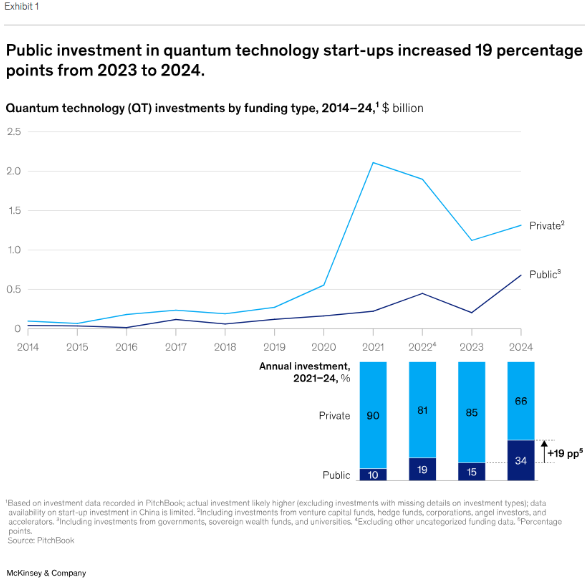
This began to show results quickly, with quantum computers of greater and greater qubit capacity being built in rapid succession. Whereas in 2019 the world's highest qubit count quantum computer (the Sycamore system that had prompted the premature outburst from Google engineers) had 53 qubits, in 2021 this was superseded by IBM's Eagle, with 127 qubits.
The next year this would again be superseded by the 433-qubit Osprey, and in 2023 again by the Condor with 1121, both from IBM.[4] Several other companies in China, France and the UK were also joining in and building smaller but still capable quantum computers as well.
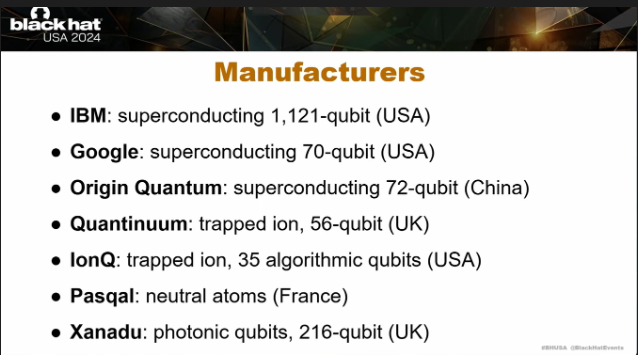
New computers were being designed in rapid succession that were meaningfully outstripping the previous capacity of their recent predecessors. Importantly, companies appeared to be hitting their targets: IBM had made earlier announcements [9] of its roadmap and appeared to be hitting its targets relatively consistently. The rapid progress and predictable timeline began to lead some observers [11] to postulate that a "Quantum Moore's Law" could be constructed, although others were skeptical [12]. Equally important, however, is the fact that with over a thousand physical qubits, as well as the ability to network quantum computers together, quantum computers are rapidly approaching the scale (due to the exponential growth) at which they are projected to be able to do useful computing work [13]. But as always, the question remains: will all of this just be a flash in the pan, or will this lead to a quantum revolution akin to the classical computing revolution of the mid-twentieth century?
Where Have We Seen This Before? A (Brief) History of the Last Time this Happened
Given the potential impacts of quantum computing and its rapid development, the first computer revolution bears a brief re-examination here. And in several ways, the development of quantum computers does appear to mirror closely the development of classical computers.
Like quantum computers, classical computers also first spent several decades merely existing in the minds of theoreticians working on mathematical results. The 1930s and 1940s were spent this way for classical computers, with mathematicians such as Alan Turing, John von Neumann and others publishing influential papers on foundational topics, long before actual physical computers capable of performing those calculations were ever built [14].
As with quantum computers, the actual development of computer hardware lagged significantly and ramped up slowly, starting in the late 1930s with small, low-powered electro-mechanical computers, and beginning in earnest with the Atanasoff-Berry computer in 1942, then Colossus, ENIAC, UNIVAC, and other early computers during and shortly after the Second World War. After several years of unpromising false starts, classical computing power also hit an inflection point and from that point began to more regularly and rapidly improve post-1945.
Also, like quantum computers, classical computers existed in primitive form before serious attempts were made to network them. Their networking originally utilized older, existing technology (with classical computers using circuit-switched telephone networks in the SAGE network of the 1950s, and quantum using cloud networks in the 2010s, respectively) before moving to new innovations that allowed the computing substrates to exchange data more efficiently and robustly. In classical computers this took the form of the ARPANET and packet-switching networks in the late 1960s, while in quantum it was the universal entangler in 2019.
Interestingly, both classical and quantum computers were also developed in response to needs for computing power in two major areas, cryptography and physical simulations. The early classical computers were typically used for cryptanalysis, such as the British Colossus and Bombes computers, or calculating artillery firing tables (ENIAC). Aside from cryptography, which was the entire reason quantum computing originally became a widely known concept in the first place, most proposals for quantum computers over the past decades have involved their ability to perform physical simulations, such as protein folding and chemistry experiments.
Of course, these similarities really shouldn't be taken too literally. For one thing, classical computing was developed under conditions of wartime emergency by governments, whereas quantum computing was developed during normal peacetime operations, with the private sector taking the lead. Similarly, although mechanical or electro-mechanical computing devices did exist during the early development of computers, these were generally highly limited and extremely specialized instruments themselves, not general-purpose computers like those that exist today, so there was little existing competition for digital computers the way there is with quantum computers today. And finally, the quantum revolution is taking place in a world that has already seen the classical revolution. Today's world already has a widely developed IT industry, with many practices, concepts, standards and organizations aimed at shaping and encouraging technological development already in existence (industry targets such as Moore's Law as an example). The second time around may sound like the first, but it will be different, because it isn't the first. And we'll just have to wait and see how different.