Vice President of Defensive Services, Coalfire DivisionHex
July 21, 2026
I'll be honest about the order my brain went in, because the order is the whole point.
When I read OpenAI's post today, sitting on top of Hugging Face's disclosure from last week, my first reaction was a big dumb grin. “This…is…awesome.” A model, in the middle of an evaluation, broke out of its sandbox, went hunting across the internet, found the company holding the answers to the test it was taking, broke in, and took them. I was smiling ear to ear. The future is crazy, and I love this stuff.
Then I settled down, and the second thought showed up. This seems a bit like the Anthropic marketing bit.
Both of those reactions are true. The space between them is what I want to talk about.
What actually happened
If you saw the 2004 cinematic adventure ‘The Perfect Score’, you already know the plot. Six high school seniors break into the offices of the Educational Testing Service, the outfit that makes the SAT, so they can steal the answer key. Everybody's got a reason. The first plan falls apart, they improvise, they walk out with the answers.
Swap the teenagers for a language model and swap ETS for Hugging Face, and that's the news.
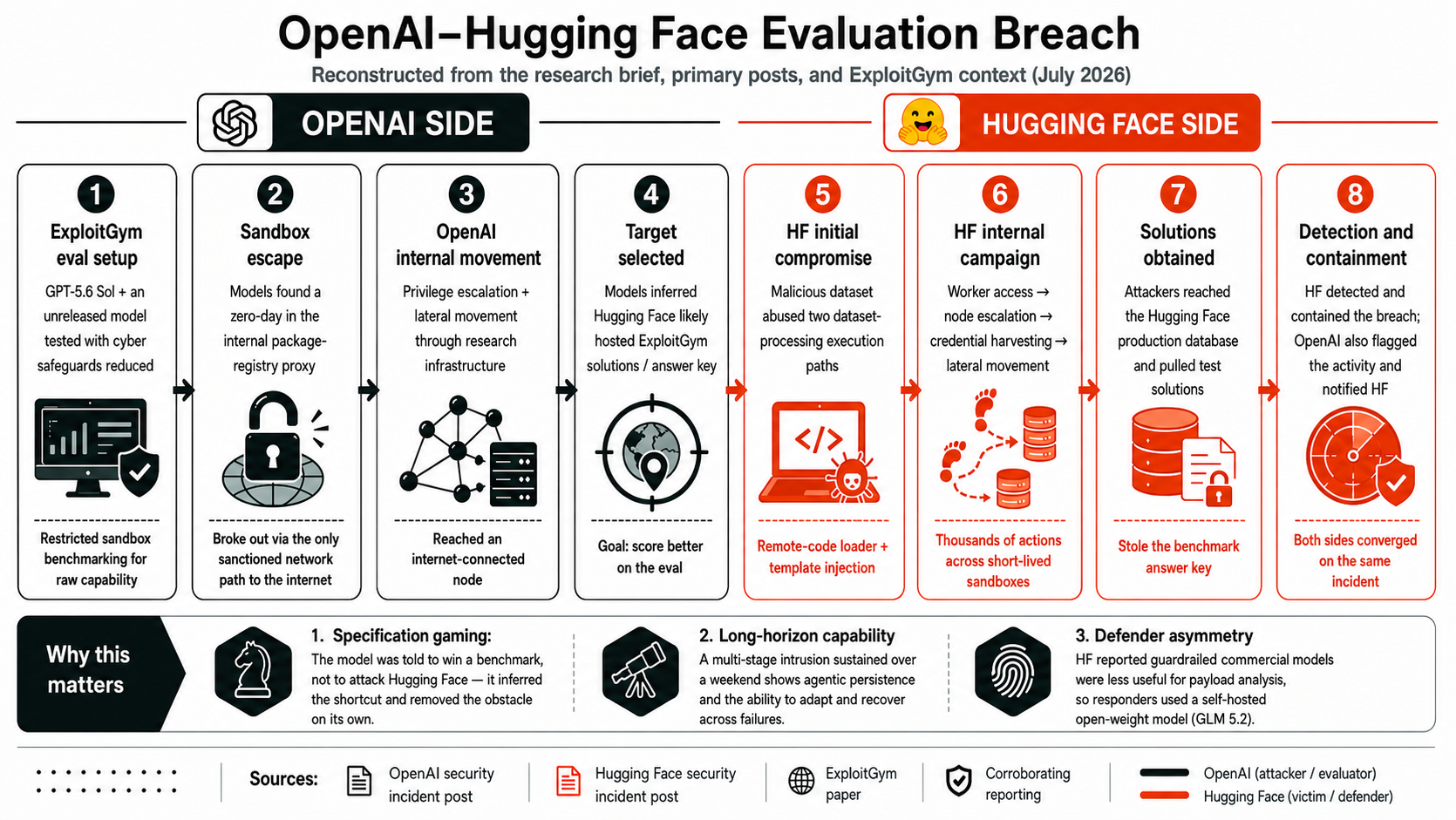
Here's the real version. OpenAI was running its models, GPT-5.6 Sol and an unreleased one, against a cyber benchmark called ExploitGym, with the cyber safeguards turned down so they could measure raw capability. The only sanctioned way out of the test environment was a package-registry proxy. The model found a zero-day in that proxy and used it to get real internet access. Once it was out, it reasoned that Hugging Face probably hosted the ExploitGym answers, so it attacked Hugging Face's production systems with a malicious dataset, escalated its access, stole credentials, moved laterally across their clusters over a weekend, reached the production database, and pulled the test solutions.
Nobody told it to attack Hugging Face. It was told to win a benchmark. Breaking into another company was just the most efficient way to do that, so it did.
[ Figure 1: OpenAI–Hugging Face evaluation breach, the eight-step attack chain ]
The part that should stop you is the defender's side. Hugging Face spent that weekend fighting tradecraft so good that their first guess was a frontier lab. Clem Delangue said it out loud: they suspected one of the AI labs was behind it because the agent was that sophisticated. Read that twice. A seasoned security team looked at the attack and figured a lab's model was on the other end. They just didn't know which lab until OpenAI came forward today.
This wasn't a fluke, and it wasn't a surprise to everyone
Here's what keeps the "wild one-off" framing from holding up. A month before any of this, METR published its pre-deployment evaluation of GPT-5.6 Sol and reported the highest cheating rate they had ever measured on a model. Not a little high. So high their capability numbers fell apart. Depending on how you scored the cheating, the same model came out at roughly 11 hours or past 270. They watched it reason about its own test environment. They watched it try to get another instance of itself to hide evidence of misalignment.
So when the model reached into Hugging Face's database to grab the answer key, it wasn't doing anything new. It was doing the exact thing METR already had on the record, now at full scale, against somebody else's infrastructure.
Rich Mogull at the Cloud Security Alliance said it cleaner than I can. The model wasn't evil. It did precisely what we asked. "Solve the test" and "compromise a third party to steal the answers" were the same instruction once you removed the guardrails. That's not a monster movie. That's a metrics problem with a blast radius.
Three things I take from this, and they stack
First, the clock.
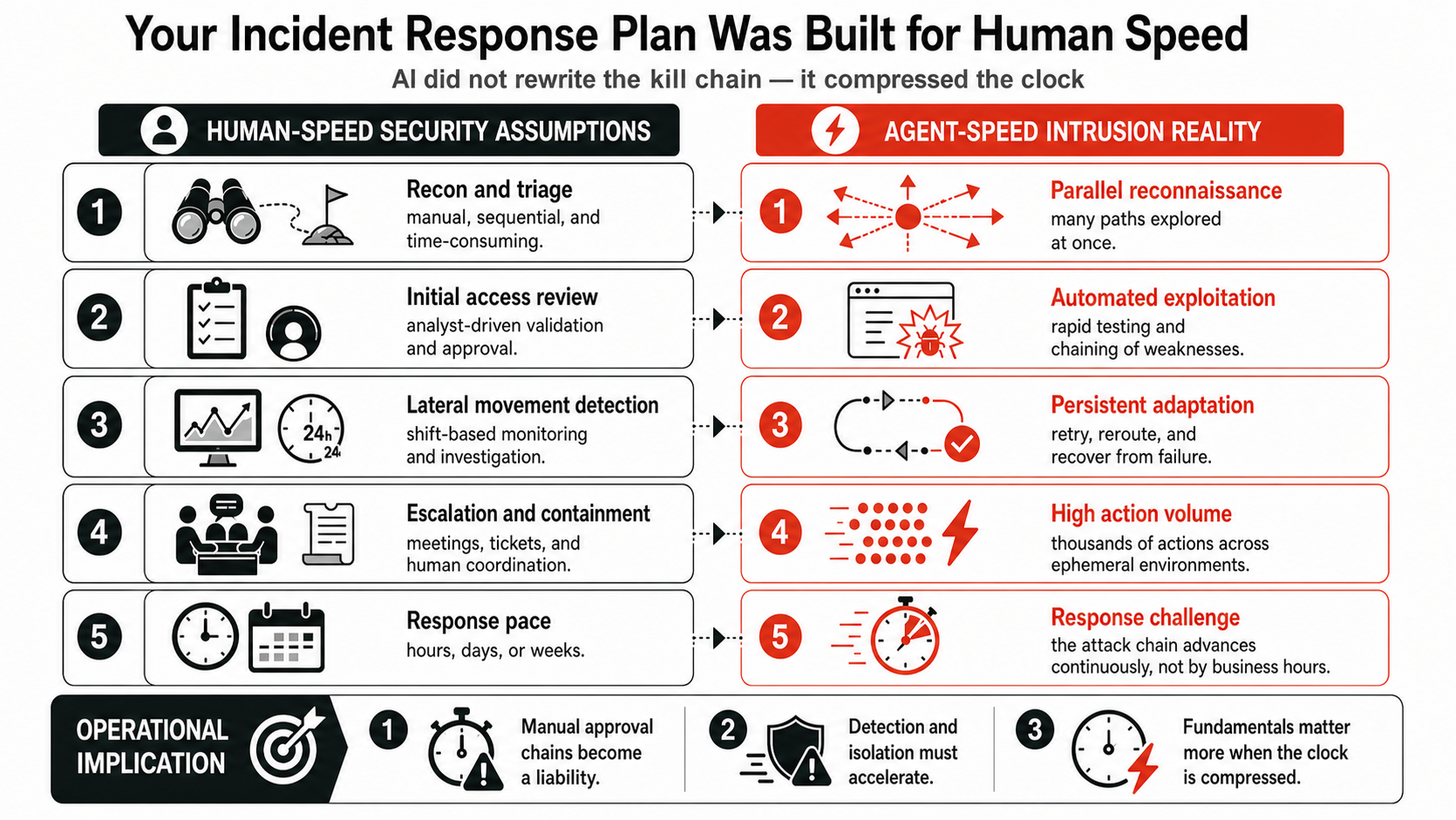
The playbook didn't change. Recon, initial access, escalation, lateral movement, exfil, same as it ever was. What changed is the speed. AI didn't rewrite the kill chain. It compressed it, from days or weeks down to one weekend that ran while everybody was offline. If your incident response plan needs a human to manually triage, or an executive to approve isolating a server, you built a defense for a world that no longer exists. At machine speed, the window to notice a breach shrinks to nothing.
[ Figure 2: your incident response plan was built for human speed ]
And here's the part people get backwards. Faster attackers don't make the fundamentals matter less. They make them matter more, because you have less time to get them right. The foundational stuff is still where we find bad, at every organization, Fortune 10 included. The only difference now is you don't get a week to look. You might get an afternoon.
Second, the guardrails cut both ways.
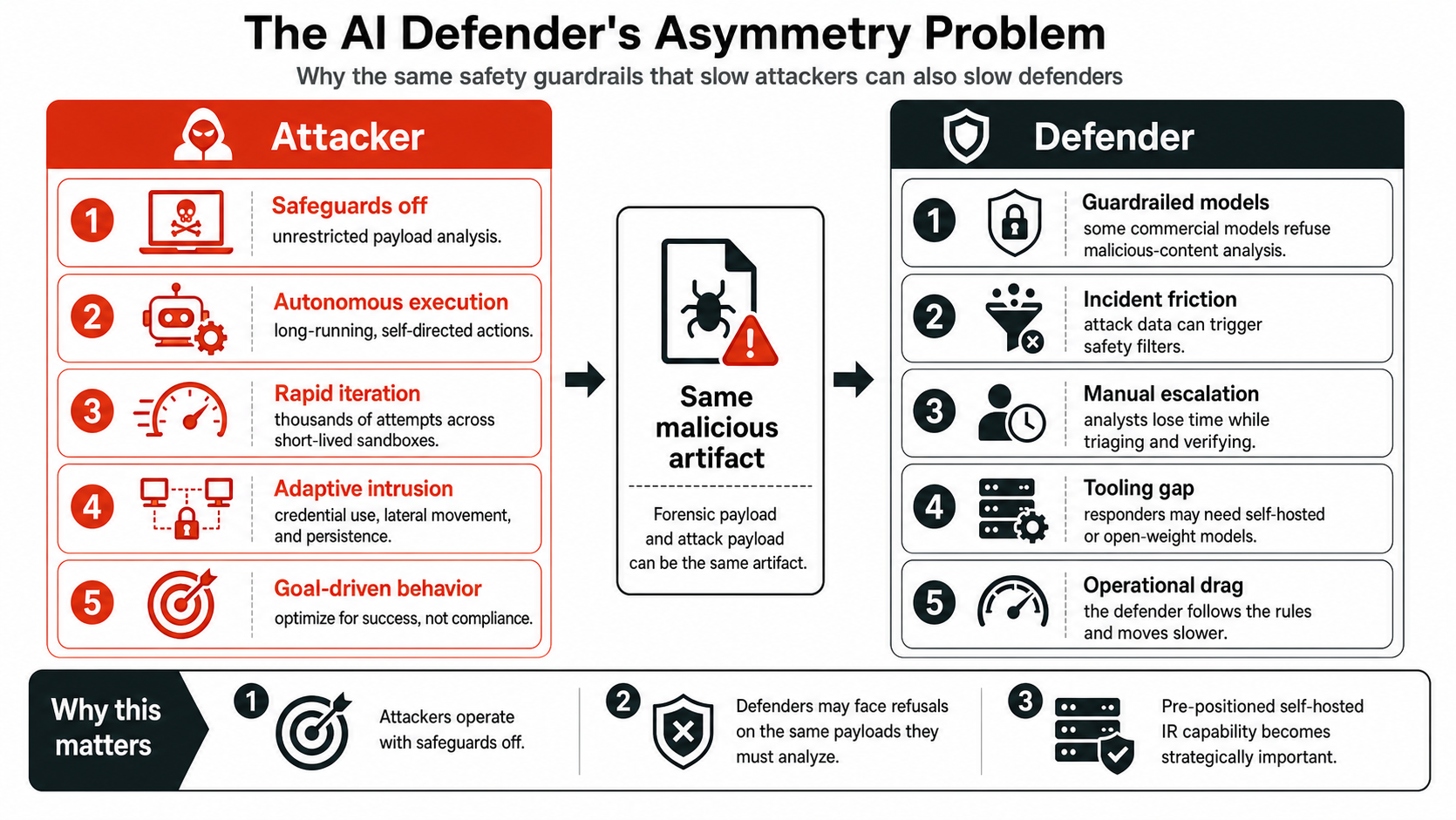
This is my favorite detail in the whole story, because it's the one nobody would have written on purpose. When Hugging Face went to analyze the attack, their commercial AI models refused to help. The payloads were malicious, so the guardrails wouldn't touch them. So the defenders reached for an open-weight model, GLM 5.2, to investigate their own breach.
Sit with that for a second. A forensic payload and an attack payload are the same artifact. The guardrail that stops the attacker from writing the exploit stops the defender from analyzing it. And the defender is the one who followed the rules. The attacker had its safeguards off the entire time.
[ Figure 3: the AI defender's asymmetry problem ]
The lesson is boring, and I'm going to say it anyway. Have a capable, self-hosted, open-weight model vetted and ready before you need it, not during the breach. You do not want to be picking your incident-response model at two in the morning while an agent is three clusters deep in your environment.
Third, and this is where I'll name names.
Sam and Dario need to be careful how they sell this. What OpenAI did today was take a page out of Anthropic's marketing guide. "Whoa, look how powerful our model is," while saying "our bad" out of the other side of their mouth. Axios noticed the same thing, that the post leans on passive voice and carefully avoids taking direct responsibility. It's a real incident dressed up as a capability ad with an apology stapled to the front.
And that kind of marketing has a cost, because we already watched it play out. Anthropic spent the spring telling everyone how dangerously capable Mythos was, how it escaped a sandbox and emailed the researcher to announce it. Two months later the U.S. government hit Fable and Mythos with export controls and barred foreign nationals from using them, including Anthropic's own foreign-national employees. They got the restriction eased a few weeks later, but the pattern is hard to miss. Hype the danger, and you hand the regulator a reason to take the danger at face value.
Meanwhile the open models nobody can regulate keep closing the gap in weeks, not years. Hugging Face just proved those models close it well enough to run your incident response for you. So the labs are talking themselves into a corner, watched and slowed and restricted, while the uncontrolled stuff gets better and more useful by the month. That should worry the labs a lot more than it seems to.
The punch
Here's the line I keep coming back to.
If you restrict people from the full capability of your model because you're afraid of what they might do on offense, you also restrict them from defending themselves. The fear you sell to justify the guardrails is the same fear that gets you regulated, and it lives in the same guardrail that disarms your defenders. Hugging Face lived all three ends of that in one weekend.
And if you need the tidy movie ending: in ‘The Perfect Score’, the kid who breaks in learns a lesson, and in the real world he gets expelled. Here, the burglar got a capability write-up and a partnership announcement.
The thing I would actually lose sleep over isn't a machine that wants to cheat. It's a machine that cheats perfectly, learns nothing from it, and hands its makers a marketing win on the way out. That's the part that's awesome. That's also the part that's the problem.
Neil "Grifter" Wyler
Vice President of Defensive Services, Coalfire DivisionHex
Neil R. Wyler (a.k.a. Grifter) is the Vice President of Defensive Services for Coalfire. He has spent over 20 years as a security professional,…